

Building a custom pool should feel effortless, but Montgomery County homeowners often discover that turnkey construction is far more complex than the promise of a finished backyard oasis. With your contractor handling every detail from design to delivery, a turnkey pool project offers convenience and price certainty. Still, realistic expectations and clear communication are key when navigating fixed contracts, site challenges, and desired amenities. This guide breaks down essential steps, common misconceptions, and customization options for creating the perfect outdoor retreat.
Table of Contents
- Turnkey Pool Construction Defined And Debunked
- Step-By-Step Turnkey Pool Building Process
- Customization And Add-On Outdoor Amenities
- Comparing Turnkey Vs. Traditional Pool Projects
- Cost, Timeline, And Key Homeowner Considerations
Key Takeaways
| Point | Details |
|---|---|
| Understanding Turnkey Projects | Turnkey pool construction means one contractor manages design, permits, construction, and delivery for a fixed price. Clear initial communication is essential for success. |
| Cost and Timeline Certainty | Turnkey contracts provide budget certainty, but unforeseen site conditions or design changes may impact final costs and timelines. Homeowners should account for these factors. |
| Role of the Homeowner | Homeowners still need to define budgets, styles, and timelines upfront, emphasizing careful planning before construction begins. |
| Customization Options | Customization enhances the pool experience, so plan additional features during the design phase for cost efficiency and functional integration. |
Turnkey Pool Construction Defined and Debunked
Turnkey pool construction sounds simple: you hire a contractor, they handle everything, and you get a finished pool. But the reality is more nuanced, especially for Montgomery County homeowners with specific backyard visions.
A turnkey pool project means the contractor takes complete responsibility for design, permits, construction, and final delivery. You turn the key, and the pool is ready to use. The contractor absorbs most of the planning complexity and risk.
However, understanding turnkey contracting frameworks reveals that owner expectations often diverge from actual outcomes. Fixed-price contracts provide budget certainty, but unexpected site conditions, design changes, or permit delays can still impact timelines and final quality.
What Turnkey Actually Means
Turnkey encompasses three core phases:
- Design phase – The contractor develops plans matching your vision and local codes
- Engineering and procurement – Selecting materials, permits, and technical specifications
- Construction execution – Building the pool from start to finish with all final touches included
Turnkey projects deliver certainty in price and schedule by placing design-build responsibility entirely on the contractor, but success depends on clear initial communication and realistic expectations.
Federal standards define turnkey construction as delivering a fully operational facility where the contractor manages every phase under a fixed-price agreement. This simplifies management for you but requires detailed contractual terms upfront.
Common Turnkey Myths in Houston
Myth 1: Turnkey means zero input from you. Wrong. You’ll define your budget, style preferences, and timeline before work begins. The contractor then executes your vision within those parameters.
Myth 2: Prices never change. Mostly true for fixed-price contracts, but site-specific challenges like unexpected rock or soil conditions, or significant design modifications you request, can trigger legitimate change orders.
Myth 3: It’s faster than traditional construction. Not necessarily. Turnkey consolidates phases, but Montgomery County permit timelines remain constant regardless of your contract structure.
What Makes Turnkey Different
Compare turnkey to design-bid-build approaches:
| Aspect | Turnkey | Design-Bid-Build |
|---|---|---|
| Responsibility | Single contractor | Multiple parties |
| Price certainty | High (fixed price) | Lower (separate bids) |
| Timeline control | Contractor-driven | Owner coordination |
| Design changes | Often costly | Easier to manage |
| Owner involvement | Upfront planning | Throughout project |
Turnkey works best when you have clear expectations from day one. It reduces your management burden but limits flexibility once construction starts.
Pro tip: Invest time in the initial design and contract phase—detailed specifications and clear change-order procedures prevent costly misunderstandings and ensure your finished pool matches your vision.
Step-by-Step Turnkey Pool Building Process
When you hire a contractor for turnkey pool construction, you’re not just handing over a check and waiting for magic. The process follows a deliberate roadmap with clear phases, each building on the last.
Understanding this journey helps you know what to expect and when. For Montgomery County homeowners, this visibility prevents surprises and keeps projects on track.
Phase 1: Design and Planning
Everything starts with your vision meeting reality. Your contractor gathers information about your backyard, budget, and preferences.
During this phase:
- Site assessment determines soil conditions, drainage, and space constraints
- Detailed design incorporates your style preferences and local code requirements
- Budget confirmation locks in the fixed price for the entire project
- Swimming pool design standards must guide structural and safety specifications
Your contractor produces detailed plans for permit submission. These aren’t rough sketches—they’re precise engineering documents that comply with Montgomery County regulations.
Phase 2: Permits and Approvals
No shovel goes in the ground without written permission from local authorities. Permit requirements protect your investment and ensure code compliance.
Your contractor handles:
- Submitting engineered plans to Montgomery County
- Obtaining building permits and aquatic facility permits
- Scheduling required inspections
- Paying applicable fees
Permits aren’t bureaucratic obstacles—they’re your protection, ensuring the pool meets safety and construction standards before work begins.
This phase typically takes 2-4 weeks depending on county backlog. It’s built into the turnkey timeline, so delays here don’t catch you off-guard.
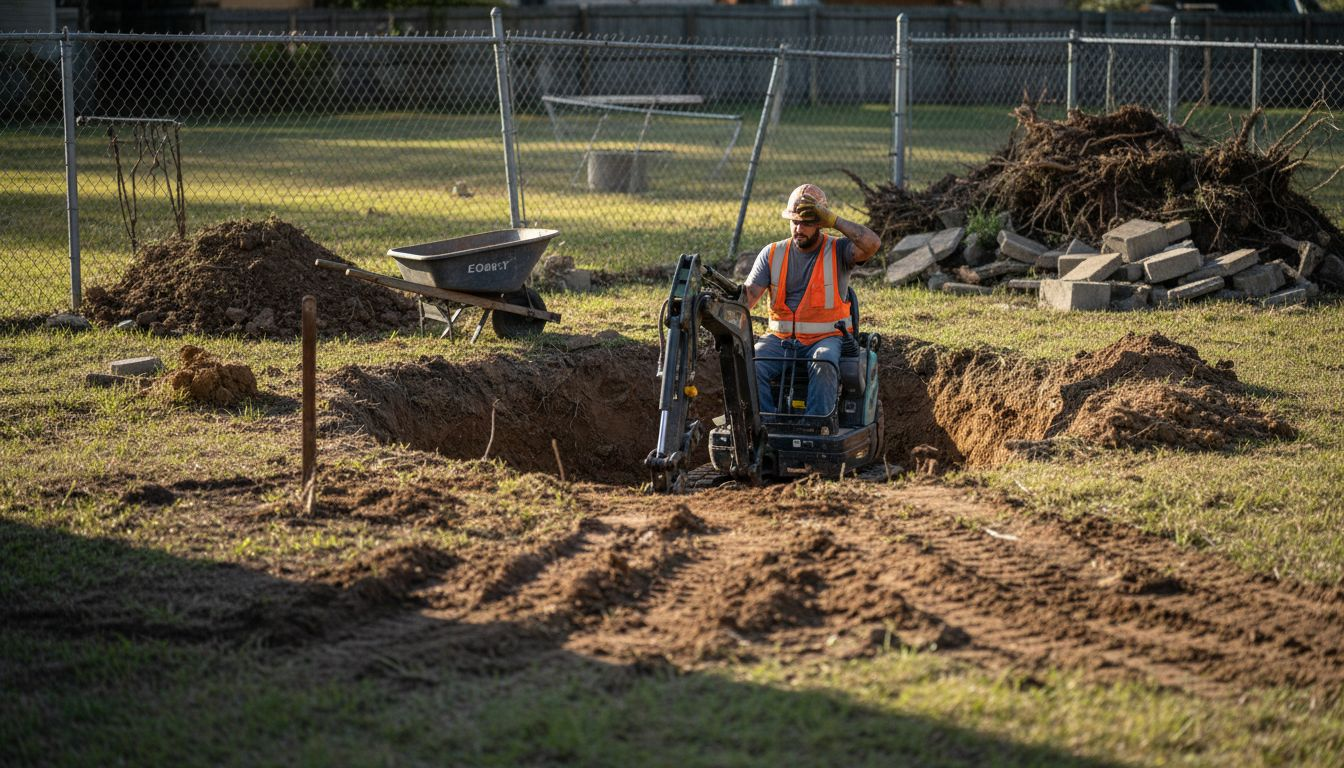
Phase 3: Site Preparation and Excavation
Once permits are approved, your contractor prepares the backyard. This means marking the pool footprint, locating underground utilities, and removing soil.
Key steps include:
- Utility locating (electricity, gas, water, septic lines)
- Ground excavation to the proper depth and dimensions
- Subgrade compaction to prevent settling
- Initial equipment pad preparation
This phase creates visible change fast. Your backyard transforms from flat to a hole—which can feel chaotic but represents real progress.
Phase 4: Shell Construction
How the pool shell is built depends on your chosen method. Most custom pools in the Houston area use gunite (sprayed concrete).
The shell construction process involves:
- Placing rebar reinforcement
- Applying gunite in multiple layers
- Shaping and sculpting the pool bottom and walls
- Allowing proper curing time
Pool construction processes vary, but gunite remains the standard for durability and custom shapes in Texas.
Phase 5: Mechanical Systems Installation
After the shell hardens, your contractor installs pumps, filters, and circulation equipment. These systems keep water clean and safe.
Included in this phase:
- Equipment pad construction
- Pump and filter installation
- Piping and electrical connections
- Gas line hookup (if heating is included)
This is where the pool becomes a living, breathing system rather than just a concrete hole.
Phase 6: Finishing and Features
Final touches transform the functional pool into your backyard oasis. Finishing includes:
- Plaster or coating application to the interior shell
- Deck installation and paving
- Coping and water feature placement
- Landscaping around the pool perimeter
If your turnkey package includes upgrades like an outdoor kitchen or fire pit, these are typically installed during this phase.
Phase 7: Testing and Startup
Before you swim, your contractor performs thorough testing. Water chemistry, filtration, and all equipment must pass inspection before handoff.
Tests include:
- Water chemistry balancing
- Equipment performance verification
- Circulation system testing
- Safety feature inspection
Pro tip: Ask your contractor for a detailed equipment manual and training session during startup—knowing how to adjust chemicals and operate your system prevents costly service calls down the road.
Customization and Add-On Outdoor Amenities
A turnkey pool is just the starting point. What transforms it into your personal resort is what you build around it. Customization and add-ons turn a functional backyard into a destination.
Montgomery County homeowners increasingly view pools as the centerpiece of outdoor living spaces. Smart additions amplify that investment and create year-round entertainment zones.
Popular Outdoor Kitchen Additions
An outdoor kitchen extends your entertaining season and eliminates trips inside. Built adjacent to the pool, kitchens create natural flow for gatherings.
Common elements include:
- Granite or stainless steel countertops
- Built-in grills and burners
- Refrigeration and ice makers
- Sink and prep stations
- Storage cabinets and shelving
Outdoor kitchens range from basic grilling stations to fully equipped culinary spaces. Budget and space determine your options, but even modest setups dramatically improve poolside entertaining.
Fire Features and Heating
Fire pits and fireplaces extend your pool season into cooler months. They create ambiance that water features alone cannot match.
Options include:
- Propane or natural gas fire pits
- Outdoor fireplaces with chimney systems
- Tabletop fire bowls for intimate settings
- Fire tables that double as seating
Fire features create gathering points that draw people away from screens and into conversation, transforming your backyard into a true social hub.
These amenities work beautifully adjacent to seating areas overlooking the pool. They’re installed during the finishing phase, integrating seamlessly with landscaping.
Pergolas, Shade Structures, and Pavilions
Shade is essential in Houston’s climate. Pergolas and pavilions provide relief while maintaining aesthetic appeal.
Shade structure choices:
- Wooden pergolas with lattice designs
- Modern aluminum pergolas with retractable canopies
- Freestanding pavilions
- Shade sails for flexible coverage
These structures frame pool views and define entertaining zones. They’re also practical, protecting furniture and reducing UV exposure for swimmers.
Water Features and Lighting
Custom water features add visual and auditory elements. Fountains, waterfalls, and sheer descent features transform pools from simple vessels into dynamic landscapes.
Popular water additions:
- Fountains and spillways
- Sheer descent waterfalls
- Bubblers and water jets
- LED lighting synchronized to color-changing systems
Lighting deserves special attention. Underwater lights, deck lighting, and landscape lighting create mood and extend usability after sunset. Modern LED systems are energy-efficient and programmable.
Safety and Compliance Features
Not all add-ons are decorative. Pool safety features protect children and guests while meeting Texas regulations.
Essential safety customizations:
- Four-sided fencing with self-closing gates
- Safety drain covers
- Rescue equipment stations
- Proper chemical storage solutions
- Emergency signage
These aren’t optional extras—they’re code requirements that your contractor integrates into the design. Safety-first customization protects liability and creates peace of mind.
Water and Energy Efficiency
Smart customization also means efficiency. Pool water efficiency features like covers, variable-speed pumps, and solar heating reduce operating costs and environmental impact.
Energy-smart additions:
- Pool covers that reduce evaporation
- Variable-speed pump systems
- Solar heating panels
- Energy-efficient filtration systems
These upgrades cost more upfront but pay for themselves through reduced utility bills. Houston’s year-round warmth makes solar heating particularly attractive.
Here’s a quick overview of what each major add-on feature contributes to your pool area:
| Add-On Feature | Main Benefit | Typical Impact on Enjoyment |
|---|---|---|
| Outdoor Kitchen | Promotes entertaining, socializing | Increases gathering opportunities |
| Fire Pit or Fireplace | Extends seasonal use, adds ambiance | Warmer, inviting atmosphere |
| Pergola or Pavilion | Provides shade and protection | Enhances comfort outdoors |
| Water Feature | Adds visual/auditory interest | Creates a relaxing environment |
| LED Lighting | Improves safety, nighttime appeal | Enables evening pool use |
| Safety Fence & Gates | Boosts safety and code compliance | Peace of mind for families |
| Efficient Equipment | Lowers operating costs | Reduces long-term expenses |
Planning Your Customizations
Customizations work best when planned during the initial design phase, not added later. Building outdoor kitchens and fire features simultaneously with pool construction is more cost-effective than retrofitting.
Consider these during planning:
- Traffic flow between house, pool, and amenities
- Existing utilities and infrastructure
- Sight lines and views from inside your home
- Future maintenance requirements
- Budget allocation across features
Pro tip: Prioritize amenities you’ll actually use rather than trendy features—an outdoor kitchen you love beats a fire pit you rarely gather around, so design your custom space around your family’s lifestyle.
Comparing Turnkey vs. Traditional Pool Projects
Choosing between turnkey and traditional pool construction feels like picking between two different philosophies. Each approach offers distinct advantages and trade-offs that matter for Montgomery County homeowners.
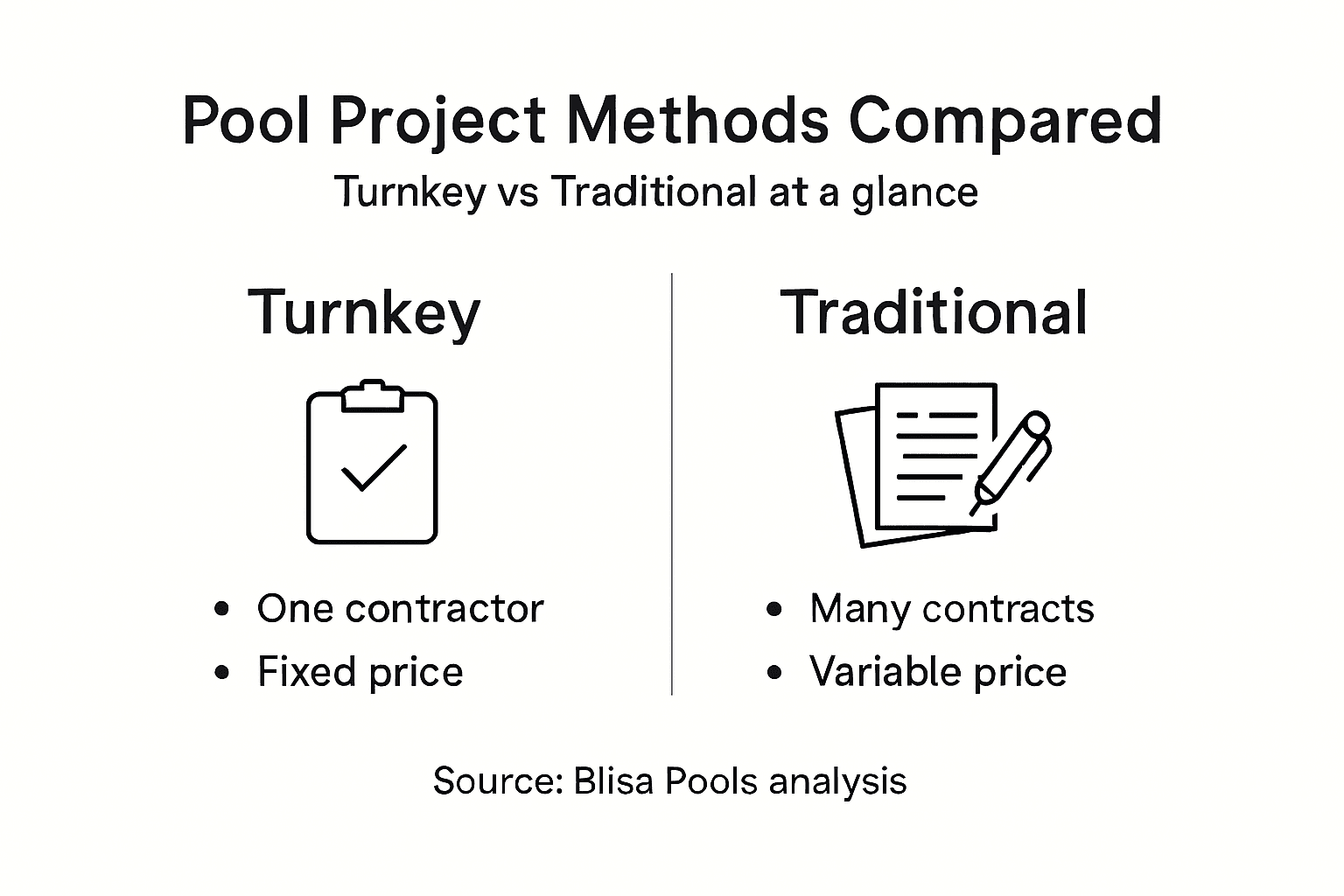
Understanding these differences helps you select the method that matches your priorities, timeline, and comfort level with project management.
How Turnkey Works
Turnkey consolidates responsibility into one contractor’s hands. They manage design, engineering, permits, and construction under a fixed-price agreement.
Key characteristics:
- Single point of contact for all decisions
- Fixed price locked in before work begins
- Defined schedule with penalties for delays
- Contractor absorbs most design and construction risk
- Limited flexibility once construction starts
You define your vision upfront, then step back while the contractor executes. This simplifies your role but requires detailed planning before the first shovel hits dirt.
How Traditional Contracting Works
Traditional projects separate design from construction. An architect or designer creates plans, then contractors bid on building them.
This method involves:
- Designer and builder as separate entities
- Multiple competitive bids from contractors
- Owner oversight throughout construction
- Ability to modify designs mid-project
- Potential cost overruns and timeline delays
Traditional projects give you more control but demand more of your time and attention.
Price Certainty Comparison
Turnkey pricing is fixed upfront. You know your total cost before construction begins, with change orders only for legitimate site conditions or modifications you request.
Traditional pricing starts with estimates. When construction begins, unforeseen conditions often trigger change orders. Understanding risk allocation in different contract types reveals why traditional projects frequently cost more than initial bids.
| Factor | Turnkey | Traditional |
|---|---|---|
| Price certainty | High (fixed) | Lower (estimates) |
| Cost overruns | Rare | Common |
| Change order costs | Higher per change | Individually negotiated |
| Hidden costs | Minimal | Possible |
For Montgomery County homeowners, turnkey’s price certainty appeals to those wanting budget predictability.
Timeline and Schedule Control
Turnkey projects have defined timelines. Delays trigger contractor penalties, incentivizing on-time delivery.
Traditional projects lack this structure. Permit delays, design changes, or coordination issues extend timelines without clear accountability. The builder isn’t penalized for missing estimates.
Fixed-price turnkey contracts transfer schedule risk to the contractor, protecting your timeline but limiting your flexibility to modify plans mid-construction.
Houston permit timelines are relatively consistent, so both methods start at similar points. Turnkey’s advantage emerges in execution—one contractor coordinating all phases beats multiple parties negotiating changes.
Flexibility and Design Changes
Want to modify your pool design after seeing excavation? Traditional projects handle this more easily. Turnkey projects charge substantial change order fees for mid-construction modifications.
This reflects how risk management differs between delivery methods. Turnkey contractors build schedule and cost buffers into fixed prices, assuming minimal changes. Flexibility costs extra.
Traditional projects accommodate changes more easily because separate contracts allow negotiated adjustments without disrupting the entire agreement.
Your Management Responsibility
Turnkey requires heavy upfront involvement, minimal involvement later. You’re detail-oriented during design, hands-off during construction.
Traditional requires ongoing management. You coordinate designers, builders, and inspectors throughout the project. This demands time and decision-making capacity.
Montgomery County homeowners with limited availability often prefer turnkey’s delegation model. Those who enjoy project involvement favor traditional’s collaborative approach.
Which Is Right for You?
Choose turnkey if you:
- Want fixed pricing and defined timeline
- Prefer minimal project management
- Have clear vision for your pool upfront
- Value certainty over flexibility
- Are willing to pay more for design changes
Choose traditional if you:
- Want design flexibility mid-project
- Enjoy hands-on involvement
- Prefer competitive bidding
- Have time for coordination and decisions
- Accept potential cost overruns
Pro tip: Invest time in the initial design phase regardless of method—detailed specifications and clear vision prevent costly changes and dissatisfaction, making upfront planning your best investment.
Cost, Timeline, and Key Homeowner Considerations
Turnkey pool construction represents a significant investment. For Montgomery County homeowners, understanding costs, timelines, and critical decision factors prevents surprises and ensures satisfaction.
This section covers the financial and logistical realities of turnkey pool projects.
Understanding Total Pool Costs
Pool costs extend far beyond the shell itself. Average inground pool installations typically range from $50,000 to $100,000, depending on size, materials, and features.
Cost components include:
- Excavation and site preparation
- Pool shell (gunite, fiberglass, or vinyl)
- Circulation and filtration systems
- Permits and inspections
- Decking and landscaping
- Customizations and add-ons
- Equipment and startup materials
Montgomery County locations with challenging soil conditions or limited access may cost more due to excavation complexity. Add-ons like outdoor kitchens, fire pits, and premium finishes increase totals significantly.
Hidden Costs to Budget For
Many homeowners overlook indirect expenses. Cost estimation fundamentals emphasize that project scope, permits, and management fees impact final expenses beyond construction labor and materials.
Often-missed costs:
- Permit fees and inspection charges
- Site preparation beyond initial excavation
- Electrical upgrades for equipment
- Gas line installation for heating
- Landscaping restoration
- Equipment training and manuals
- First-year maintenance supplies
Ask your contractor for an itemized estimate that separates direct construction costs from permitting, inspections, and ancillary expenses.
Timeline Expectations
Turnkey projects typically take 12 to 16 weeks from design approval to completion. This includes permit processing, which accounts for 2 to 4 weeks depending on Montgomery County backlog.
Typical phase durations:
- Design and planning: 2-3 weeks
- Permit approval: 2-4 weeks
- Excavation and prep: 1-2 weeks
- Shell construction: 3-4 weeks
- Systems installation: 2-3 weeks
- Finishing and landscaping: 2-3 weeks
- Testing and startup: 1 week
Turnkey projects provide timeline certainty through fixed schedules with contractor penalties for delays, protecting you from extended construction disruptions.
Weather occasionally extends timelines. Houston’s summer heat and occasional rain can impact concrete curing and excavation phases.
Use this table to plan your timeline for each construction phase:
| Project Phase | Typical Duration | Key Consideration |
|---|---|---|
| Design & Planning | 2–3 weeks | Detailed specs, no shortcuts |
| Permits & Approvals | 2–4 weeks | Allow for county backlog |
| Site Prep & Excavation | 1–2 weeks | Weather and soil conditions |
| Shell Construction | 3–4 weeks | Curing time is crucial |
| System Installation | 2–3 weeks | Electrical, plumbing setup |
| Finishing & Landscaping | 2–3 weeks | Custom features installed |
| Testing & Startup | 1 week | Verify safety and equipment |
Financing Your Pool
Few homeowners pay all-cash for pools. Financing options include home equity lines of credit, pool-specific loans, and contractor financing.
Common financing approaches:
- Home equity line of credit (typically 4-6% interest)
- Pool financing through specialty lenders
- Contractor payment plans
- Personal loans
Fixed-price turnkey contracts make financing straightforward because your total cost is known upfront. Lenders appreciate this certainty when evaluating loan requests.
Critical Questions Before Signing
Ask your contractor these questions before finalizing any agreement:
- Does the fixed price include all permits and inspections?
- What triggers legitimate change orders?
- What happens if unforeseen site conditions emerge?
- What’s the payment schedule?
- How are delays handled contractually?
- Is equipment warranty included?
- What training and documentation do you provide?
- What happens if the project exceeds the timeline?
Detailed answers clarify expectations and prevent disputes.
Budget Contingency Planning
Even with fixed-price turnkey contracts, reserve 5 to 10 percent of your budget for contingencies. This covers legitimate change orders for unexpected site conditions or enhancements you decide mid-project.
If your pool budget is $75,000, allocate $3,750 to $7,500 for potential adjustments. This prevents financial strain if issues arise and gives you flexibility for enhancements without stress.
Pro tip: Get your estimate in writing with detailed line items for every cost component—this clarity protects you from surprise charges and gives you leverage if disputes arise over what’s included in the fixed price.
Ready to Bring Your Turnkey Pool Vision to Life with Expert Custom Pool Building
Transforming your backyard into a luxurious retreat requires more than just a simple pool installation. The article highlights the complexities Montgomery County homeowners face with turnkey pool construction such as managing design expectations, fixed-price contracts, permit challenges, and integrating custom add-ons for outdoor living. If you want to avoid costly change orders and timeline surprises it is essential to partner with a trusted builder who understands the entire process and offers clear communication from start to finish.
At Bliss Pools, we specialize in delivering turnkey solutions with over 15 years of experience crafting custom backyard environments that exceed expectations. Whether you are looking for a sleek gunite pool shell or want to enhance your space with outdoor kitchens, fire pits, and pergolas our professional team provides detailed upfront planning, transparent pricing, and premium craftsmanship designed specifically for Houston area conditions and regulations.
Explore our Custom Pool Building | Bliss Pools services to discover how we turn your vision into reality on schedule and on budget. Don’t wait while permit timelines and weather add delays Contact us at Bliss Pools today for a free estimate and start your journey toward a stunning turnkey pool that truly transforms your outdoor living experience.
Frequently Asked Questions
What is turnkey pool construction?
Turnkey pool construction is a comprehensive approach where a single contractor manages the entire pool project, including design, permits, construction, and final delivery, ensuring a ready-to-use pool with minimal homeowner intervention.
What are the main phases of a turnkey pool project?
The main phases of a turnkey pool project include the design phase, engineering and procurement, construction execution, and final testing and startup to ensure the pool is safe and functional.
How does turnkey pool construction differ from traditional construction methods?
Turnkey pool construction consolidates responsibilities under one contractor with a fixed price, providing high price certainty and reduced management duties for the homeowner compared to traditional methods that involve multiple parties and separate contracts.
Are there any hidden costs in turnkey pool construction?
While turnkey contracts aim for price certainty, homeowners should be aware of potential hidden costs related to permits, inspections, site preparation, and any customizations or change orders requested during the project.